
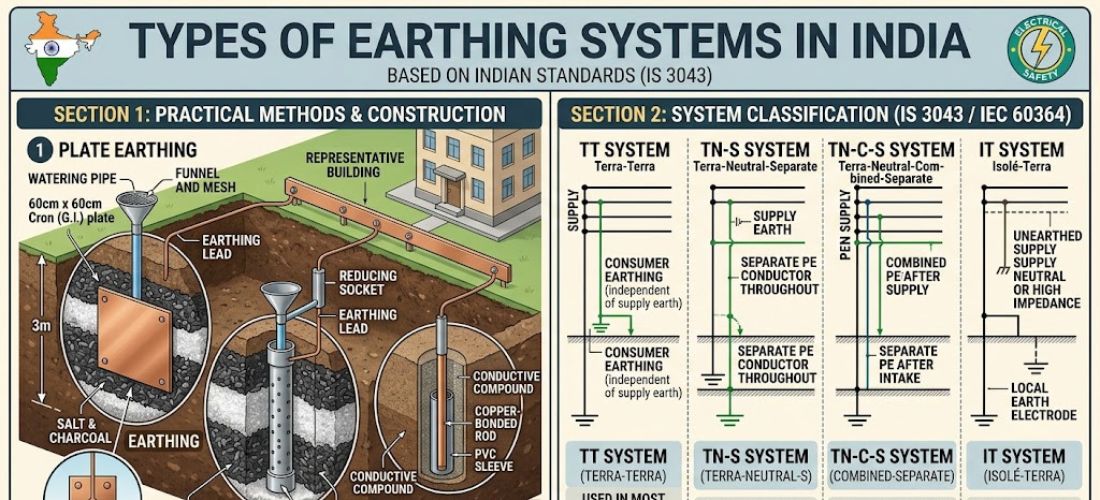
When people search for types of earthing, they usually want a clear answer to one simple question: Which earthing system is actually safe and long-lasting for their building? In India, choosing the right earthing system is not just a technical decision; it directly affects safety, equipment life, and maintenance costs. In the next few sections, you’ll understand the types of earthing system, how they work, and which one makes the most sense for your needs.
Why the Importance of Earthing Cannot Be Ignored
Whether you are building a house, running a factory, or managing a hospital, electrical earthing is the backbone of safety.
Every electrical system produces fault current. This can happen due to:
- Short circuits
- Insulation failure
- Lightning strikes
If this current doesn’t get a safe path into the ground, it can lead to:
- Electric shocks (dangerous for human life)
- Damage to expensive machines
- Fire hazards
That’s why a low-resistance earthing system is not optional; it is essential.
But here’s the real problem:
Many buildings in India still use outdated earthing methods installed years ago without maintenance. Over time, these systems stop working effectively.
So the question is, which earthing type should you trust today?
What Are the 4 Types of Earthing Systems?
If you’re wondering how many types of earthing exist, the most commonly used types of earthing systems in India are the following:
- Marconite Earthing
- Pipe Earthing
- Plate Earthing
- Chemical Earthing
These are the main earthing system types used across residential, commercial, and industrial projects.
Quick Comparison Table of Earthing System Types
| Earthing Type | Maintenance Level | Lifespan | Performance Stability | Suitable For |
|---|---|---|---|---|
| Marconite Earthing | Very Low | 40–50+ years | Very High | All soil types, industries |
| Pipe Earthing | High | 5–10 years | Medium | Homes (basic use) |
| Plate Earthing | Medium | 10–15 years | Medium | Open spaces |
| Chemical Earthing | High | 5–8 years | Low to Medium | Poor soil conditions |
1. Marconite Earthing – Modern and Reliable Earthing System
What Is Marconite Earthing?
Marconite earthing is an advanced earthing system type that uses a special conductive compound instead of traditional materials like charcoal or salt.
It creates a permanent low-resistance path for fault current.
How It Works
- A copper electrode is installed
- Marconite compound is filled around it
- The compound hardens and forms a strong conductive layer
Unlike traditional systems, it does not depend on moisture.
Benefits of Marconite Earthing
- Works in all soil types (rocky, dry, sandy)
- No water or chemical refilling required
- Long life (up to 50 years)
- Stable performance in all seasons
- No corrosion issues
Practical Insight
In many industrial setups where machines fail due to voltage fluctuations, switching to Marconite earthing has reduced breakdowns significantly. It is especially useful where downtime is costly.
Visit us: solar water pumping system
2. Pipe Earthing – Common but Maintenance-Heavy
What Is Pipe Earthing?
Pipe earthing is one of the most widely used types of earthing system in Indian homes.
It uses:
- A GI or copper pipe
- Buried vertically in the ground
- Surrounded by salt and charcoal
Advantages
- Low initial cost
- Easy to install
- Commonly used in residential buildings
Disadvantages
- Rusting over time
- Performance depends on soil moisture
- Requires regular maintenance
- Risk of current leakage
Real-Life Tip
Many homeowners install pipe earthing once and forget about it. After 4–5 years, the system often stops working due to corrosion, but people don’t realize it until a problem occurs.
3. Plate Earthing – Traditional but Space-Consuming
What Is Plate Earthing?
In this earthing type, a copper or GI plate is buried deep in the ground.
Installation Process
- The plate is placed 3 meters deep
- Surrounded by charcoal and salt
- Connected to electrical system
Advantages
- Better contact area than pipe earthing
- Stable in moderate soil conditions
Disadvantages
- Requires large space
- Digging is labor-intensive
- Not suitable for urban areas
- Can corrode over time
Practical Insight
Plate earthing is still used in some government and old infrastructure projects, but in cities, it is becoming less practical due to space issues.
Read More: solar system guide
4. Chemical Earthing – Used in Difficult Soil Conditions
What Is Chemical Earthing?
Chemical earthing improves conductivity by adding chemicals around the electrode.
Advantages
- Works in high-resistance soil
- Better than basic pipe earthing in dry areas
Disadvantages
- Requires frequent chemical refilling
- Expensive maintenance
- Environmental concerns
- Risk of corrosion
Real Insight
In some commercial projects, chemical earthing is chosen initially for performance, but long-term costs become high due to maintenance.
Other Types of Earthing Systems (Additional Knowledge)
Apart from the main four, there are a few other types of earthing systems:
Rod Earthing
- Uses a metal rod driven into the ground
- Quick installation
- Best for moist soil
Strip Earthing
- Uses metal strips buried horizontally
- Ideal for large industrial areas
Water Pipe Earthing
- Uses metal water pipes
- Outdated and unsafe method
How to Choose the Right Earthing System for Your Building
Choosing the right type of earthing system depends on:
1. Soil Condition
- Dry or rocky soil → Advanced earthing (like Marconite)
- Moist soil → Pipe or rod earthing may work
2. Type of Building
- Home → Pipe or advanced earthing
- Factory → High-performance system required
- Hospital → Highly reliable earthing essential
3. Maintenance Capability
- If you don’t want regular maintenance → Avoid chemical or pipe earthing
4. Budget vs Long-Term Cost
- Low initial cost ≠ low lifetime cost
Common Mistakes People Make While Choosing Earthing
- Choosing cheapest option without thinking long-term
- Ignoring soil testing
- Not checking earthing resistance regularly
- Using outdated systems without upgrades
Simple Tips to Improve Earthing Performance
- Always test earth resistance annually
- Use quality earthing metal like copper
- Avoid mixing different metals
- Ensure proper installation depth
- Hire experienced professionals
Advantages and Disadvantages of Different Earthing Types
Advantages
- Protects human life
- Prevents equipment damage
- Reduces fire risk
Disadvantages (if poorly installed)
- System failure
- Increased maintenance
- Safety hazards
Final Thoughts – Which Earthing System Is Best?
If you compare all earthing system types, modern solutions clearly perform better than traditional ones.
- Pipe and plate earthing are affordable but need maintenance
- Chemical earthing works but increases long-term costs
- Advanced earthing systems offer reliability and durability
For buildings where safety, performance, and long-term peace of mind matter, investing in a better earthing solution is always the smarter choice.
Disclaimer
The basic standard price of any earthing system is not fixed. It can vary depending on soil condition, location, material quality, and installation method. Anything can change based on site requirements.
By now, you should have a clear understanding of:
- how many types of earthing exist
- different types of earthing systems
- and which one fits your building best
If you’re planning a new project or upgrading an old system, don’t treat earthing as a small task, it’s one of the most important investments in electrical safety.
Read More: solar energy for commercial buildings
Frequently Asked Questions (FAQs)
1. How many types of earthing are there?
Answer: There are mainly 4 types of earthing systems used in India:
- Marconite Earthing
- Pipe Earthing
- Plate Earthing
- Chemical Earthing
Apart from these, other types of earthing like rod earthing and strip earthing are also used in specific applications.
2. Which is the best type of earthing system for homes?
Answer: For homes, pipe earthing is commonly used because of its low cost. However, if you want long-term safety and low maintenance, advanced systems like Marconite earthing are a better option.
3. What is the most commonly used earthing type in India?
Answer: Pipe earthing is the most widely used earthing system type in India, especially in residential buildings. But it requires regular maintenance to remain effective.
4. Why does earthing fail over time?
Answer: Earthing systems fail due to:
- Corrosion of metal parts
- Dry soil conditions
- Poor installation
- Lack of maintenance
That’s why choosing the right type of earthing system is important.
5. What is earthing resistance and why is it important?
Answer: Earthing resistance is the measure of how easily current flows into the ground. Lower resistance means better safety. A good earthing system ensures fast discharge of fault current.
6. Which earthing system requires the least maintenance?
Answer: Modern earthing systems like Marconite earthing require very little to no maintenance compared to pipe or chemical earthing.
7. Can earthing reduce electricity bills?
Answer: No, earthing does not reduce electricity bills. Its purpose is safety — it protects people and equipment from electrical faults.
8. How often should earthing be checked?
Answer: It is recommended to test your earthing system at least once a year to ensure proper performance.