
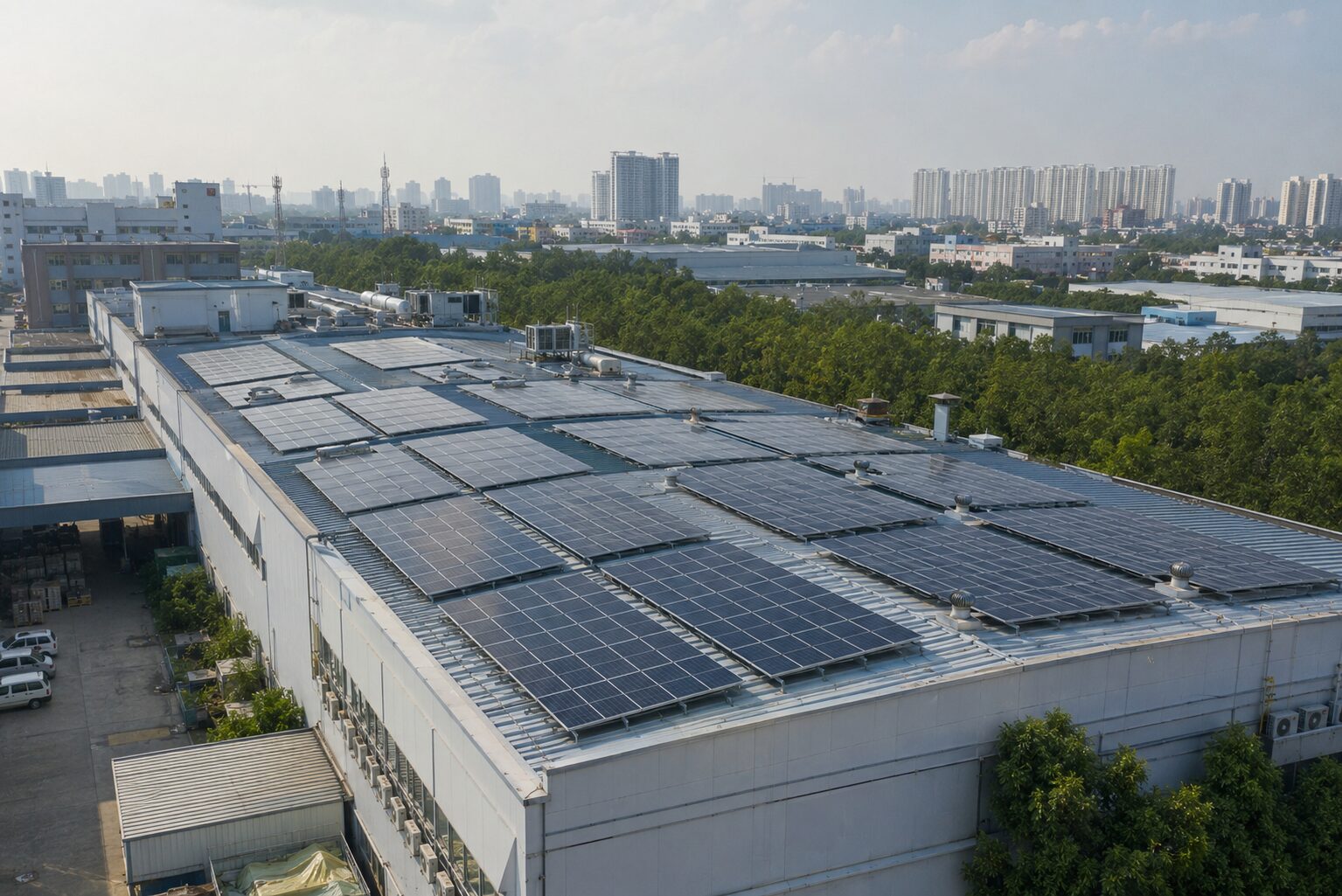
Solar installation services cover the design, approval, and setup of a commercial solar power system on a business’s rooftop or land, so a company can generate its own electricity instead of paying full commercial tariffs. For manufacturing units, warehouses, retail chains, and agro-processing facilities around Delhi-NCR, that usually means a rooftop or ground-mounted plant sized to your actual daytime load, with net metering approval and, where it applies, accelerated depreciation worked into the numbers from the start.
KLK Ventures designs and delivers commercial solar systems for manufacturing, warehousing, retail, and agro-industrial businesses across Delhi-NCR — from the first load audit through to commissioning and net metering sign-off. What follows is based on what we run into on-site, not a sales brochure.
Here’s how it usually starts, if we’re being honest about it. You’re running a factory, a warehouse, an office park — doesn’t matter which — and one month you actually look at the power bill instead of just paying it, and realize it’s crept up every year without you noticing. It’s eating into margins that should be staying in the business. That’s usually the point where someone finally picks up the phone and asks what it would take to put solar on the roof. That’s where professional solar installation services in India can help businesses reduce their dependence on expensive grid power instead of writing a bigger cheque to the discom next month too.
This isn’t an early-adopter move anymore. It’s just what serious operations do now. India’s installed solar capacity crossed 162 GW as of June 2026, according to MNRE data shared in the Rajya Sabha, and the country added a record 44.6 GW of new solar PV capacity in FY 2026 alone. Open access commercial and industrial projects were a big part of that, per JMK Research. The grid infrastructure is there. The policy backing is there. The financing is there. Whether your business actually uses any of it is really the only open question left.
Why Businesses Are Choosing Solar Over Grid Power
Commercial and industrial power costs a lot more than residential power in most states — sometimes close to double. A properly sized solar system knocks out a big chunk of your daytime draw, which happens to be exactly when factories, offices, and shops pull the most current anyway. Stretch that over 25 years of panel life and you’re not looking at a one-off discount. You’re looking at a genuinely different cost base for as long as the plant is running.
Then there’s depreciation, which doesn’t come up in these conversations nearly as often as it should. Businesses that invest in solar assets can claim accelerated depreciation under the Income Tax Act, and that alone can shave a year or two off your payback compared to a plain cost comparison. Add modules that are cheaper than they were five years ago, plus easier bank or NBFC financing, and the math on a commercial installation gets better basically every quarter you sit on it.
PM-KUSUM and Accelerated Depreciation, Sorted Out
Quick thing worth clearing up, because it trips people up constantly. PM-KUSUM is written mostly for farmers, and most of what’s online about it assumes that audience. But there’s a piece worth knowing if your business touches agriculture at all. Component A of PM-KUSUM lets farmers, cooperatives, panchayats, and rural entrepreneurs set up decentralised solar plants up to 2 MW on their own land and sell that power straight to the discom under a long-term PPA. Running a cold storage unit, an agro-processing plant, or working through an FPO? Worth a look — don’t write it off just because you’re not a farmer yourself.
For a regular factory, warehouse, or retail business, though, PM-KUSUM doesn’t apply. What matters for you is the 40% accelerated depreciation under Section 32 of the Income Tax Act, since PM Surya Ghar subsidies are for residential rooftops only — commercial consumers don’t qualify there. Stack that depreciation on top of net metering and today’s lower equipment prices, and payback often lands under five years. It’s the one thing worth pushing your vendor to talk about, even if they don’t bring it up first.
What Solar Installation Services Should Actually Include
01 Site audit and load analysis
What you’re actually consuming, what your roof or land can structurally handle, how much shadow-free area you really have — before anyone touches a design.
02 System design and net metering paperwork
Sizing the plant right, then pushing the discom approvals through so you’re not stuck chasing files for three months.
03 Component sourcing
Panels and inverters on that ALMM approved list, because that affects both performance and whether the plant is even compliant.
04 Installation and commissioning
Structural mounting, wiring, safety checks — done properly, not rushed to hit someone’s deadline.
05 Monitoring and maintenance
Someone actually watching the numbers afterward, so you find out if the plant is underperforming instead of just wondering why the bill didn’t drop as much as expected.
Most commercial solar projects that go sideways skip one of these five somewhere. It’s why the installer matters a lot more than the number on the quote.
How to Pick the Right Partner
Not every installer who sends you a proposal has actually built something at commercial scale before. A few things worth confirming before you sign anything. References from businesses roughly your size and load profile matter more than you’d think — three homes with rooftop panels don’t tell you much about how a vendor handles a factory. Make sure they’re handling the net metering application with the discom themselves too, instead of quietly handing that back to you halfway through. And read the warranty carefully: panel performance and workmanship are two different guarantees, and vendors like to blur that line when it suits them. Last thing — ask if monitoring is included after installation. A plant nobody’s watching quietly loses output, and you usually don’t notice until the bill arrives.
A team that’s actually done commercial solar work will walk you through all of this before you even think to ask.
Where Businesses Usually Go Wrong
The one we see most is undersizing the plant to keep the upfront cost down, which then doesn’t offset enough load to justify the investment in the first place. Close second is ignoring roof condition and structural capacity — that one turns into a maintenance headache a year or two later, quietly. And then there’s the classic: picking a vendor purely on price, without checking whether that company will still be around in five years when you actually need the warranty honored. Getting solar installation services right means catching all three at the design stage, not discovering them after the plant’s already up and running.
If any of that sounds like the quote sitting in your inbox right now, it’s worth getting a second opinion before you sign. Talk to KLK Ventures about a load-based design — no strings attached.
Ready to Cut Your Power Costs?
If you’re still paying full commercial tariffs every month, it’s worth getting an honest, no-obligation site assessment before your next billing cycle lands. KLK Ventures has been designing and delivering solar installation services for manufacturing, warehousing, retail, and agro-industrial businesses across Delhi-NCR, start to finish, from the load audit through to commissioning and net metering sign-off. Get in touch and we’ll size a system around what you actually use, not a template pulled off a spreadsheet