
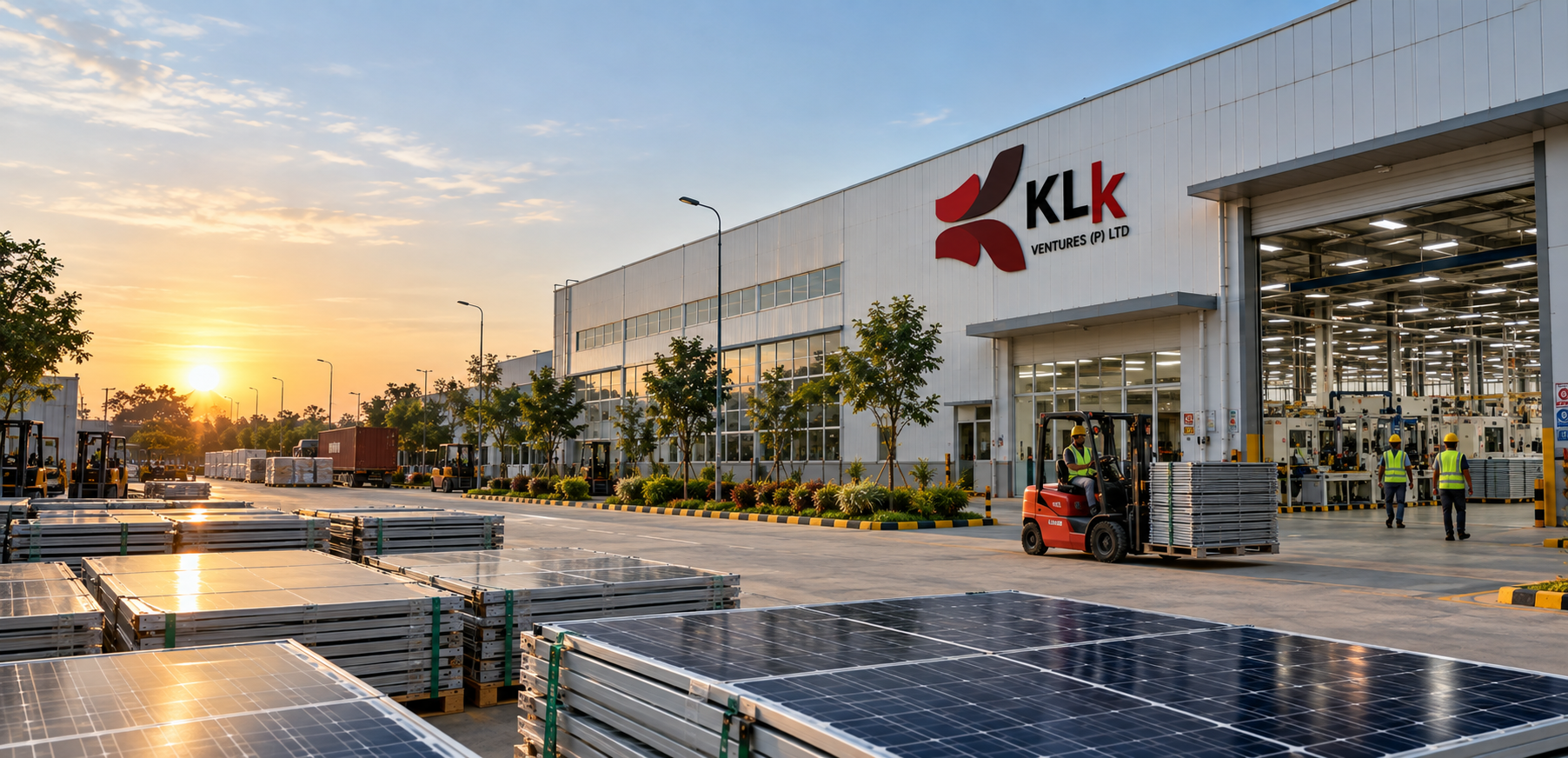
Ask five people in the industry what a solar panel manufacturing plant costs in India, and you’ll get five different answers. That’s not evasiveness, it’s just how the numbers work. Production scale, location, automation level, and the type of solar module manufacturing technology chosen all pull the budget in different directions. A 5 MW assembly line and a 500 MW integrated facility barely belong in the same conversation, cost-wise. So rather than chase a single figure, it’s more useful to break the investment into categories and work through each one.
What Factors Affect Solar Panel Manufacturing Plant Cost?
A few line items do most of the heavy lifting:
- Land and factory infrastructure
- Manufacturing machinery and automation level
- Intended production capacity (MW per year)
- Raw materials such as solar cells, glass, EVA sheets, and backsheets
- Electrical and utility infrastructure
- Testing and quality-control equipment
- Labour and skilled manpower
- Certifications and compliance requirements
- Logistics and transportation
- Working capital for ongoing operations
State policy matters more than people expect. Land rates, power tariffs, labour costs, and how fast a single-window clearance actually moves, these vary state to state and can move a solar panel factory setup budget by a fair margin before a single machine is installed.
Solar Panel Manufacturing Plant Cost Breakdown
| Cost Category | Investment Level |
|---|---|
| Land and building | Project-dependent |
| Machinery and automation | High |
| Raw materials (initial stock) | Moderate to High |
| Utilities and power setup | Moderate |
| Testing and QC equipment | Moderate |
| Certifications and compliance | Low to Moderate |
| Working capital | Project-dependent |
Use this as a starting framework, not a quote. Capacity, automation, and state all move these numbers.
How Manufacturing Capacity Changes the Investment
Capacity decides almost everything else. A small unit gets by with a modest shed and a handful of machines. Scale up to hundreds of megawatts and suddenly you’re talking about a much bigger building, multiple production lines, and a testing lab that can keep pace with output. Get the capacity target right first, and the rest of the budget tends to fall into place around it.
Machinery Required for a Solar Panel Manufacturing Plant
A standard solar cell manufacturing plant or module line runs on equipment for cell sorting, tabbing and stringing, lamination, framing, and electroluminescence (EL) testing. How much of this is automated is really the main lever on solar plant machinery cost. Semi-automated lines are cheaper to set up but lean on labour long-term. Fully automated lines cost more on day one but usually pay that back in consistency and throughput.
Other Costs to Consider Before Setting Up a Solar Manufacturing Plant
The costs that catch people off guard are rarely the big ones. It’s the smaller, recurring items:
- Installation and commissioning
- Power consumption during production
- Ongoing maintenance
- Quality testing at multiple stages
- Packaging for finished panels
- Transportation and logistics
- Initial raw material inventory
- Employee training
- Working capital to cover the first few operating cycles
Budget for these from the start. They’re easy to forget in a spreadsheet and hard to ignore once the plant is running.
Is Setting Up a Solar Panel Manufacturing Plant a Good Business Opportunity?
There’s no blanket yes or no here. It comes down to market demand in the region you’re targeting, the scale you can actually sustain, the technology you go with, product quality, how reliable your supply chain is, what the competition looks like, financing, state and central regulatory requirements, manufacturing efficiency, and what it costs to keep the lights on long after launch. None of this guarantees a return. It just tells you what to check before you commit capital.
How to Estimate Your Solar Panel Manufacturing Plant Cost
A simple way to frame the budget:
Total project cost = Land + Building + Machinery + Utilities + Testing + Installation + Compliance + Initial Inventory + Working Capital + Other Project Expenses
Run each of these against your intended capacity and manufacturing model, whether that’s a basic assembly setup or a fully integrated cell-to-module operation.
Why Choose KLK India for Solar Solutions?
KLK runs manufacturing facilities in Noida and Bihar, producing Mono c-Si PERC solar modules, LiFePO₄ batteries, and solar streetlights, with products approved by the Ministry of New and Renewable Energy (MNRE) and listed in the ALMM. That’s a company with an actual production footprint, not just a services desk, which means real familiarity with what setting up and running a solar manufacturing operation in India involves. If you’re weighing a similar project or just trying to make sense of the requirements, that kind of on-ground experience is worth tapping into.
Get in touch with the KLK India team to talk through your project and figure out a realistic budget.
Frequently Asked Questions
What is the solar panel manufacturing plant cost in India?
It varies significantly based on production capacity, automation level, and location, so it’s best worked out on a per-project basis rather than quoted as a fixed figure.
What factors affect the cost of setting up a solar panel manufacturing plant?
Land and infrastructure, machinery and automation, raw material sourcing, utilities, labour, certifications, logistics, and working capital all play a part.
How much land is required for a solar panel manufacturing plant?
It depends on the production capacity and plant layout you’re planning for. Larger, more automated facilities generally need more space than smaller assembly units.
What machinery is required to manufacture solar panels?
Core equipment includes cell sorting, tabbing and stringing, lamination, framing, and electroluminescence testing machines, with automation level driving both cost and output consistency.
What should be included in a solar panel manufacturing plant project budget?
Land, building, machinery, utilities, testing equipment, installation, compliance, initial inventory, and working capital should all be accounted for.
RESOURCES:-
Ministry of New and Renewable Energy (MNRE)
Official ministry site, for the ALMM and compliance mentions.
What is ALMM — CEEW explainer
https://www.ceew.in/cef/quick-reads/explains/what-is-almm
Plain-language background on the Approved List of Models and Manufacturers.