
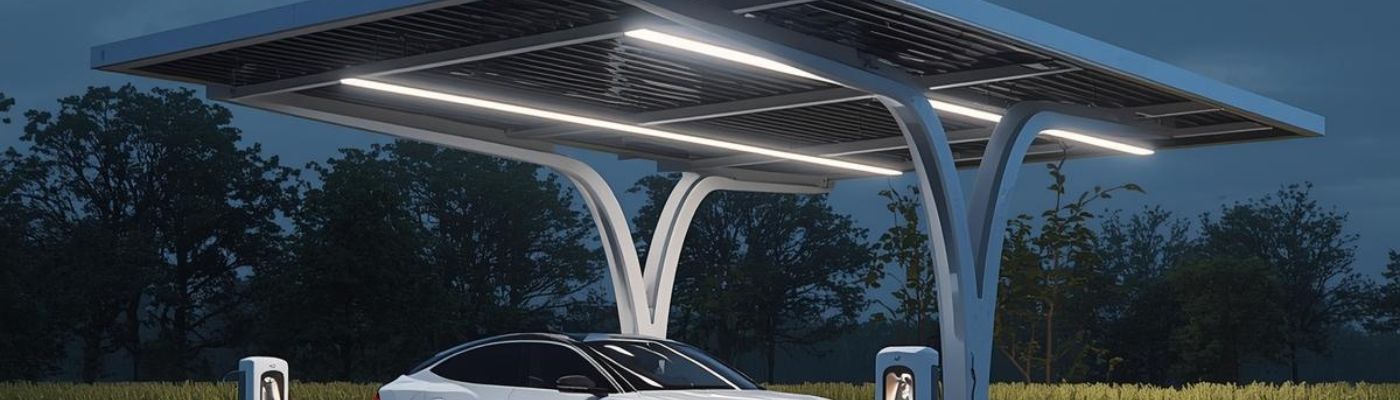
A solar carport is a smart structure that turns your parking space into a clean energy source. Instead of a normal shed or parking shade, it uses solar panels on the roof to generate electricity while protecting vehicles from sun and rain. In solar carport India, these systems are becoming popular for homes, offices, factories, malls, and public spaces because they solve two problems at once-parking and power generation.
In simple words, a solar carport means “park your car and produce electricity at the same time.”
What Is a Solar Carport?
A solar carport is a covered parking structure with solar panels installed on top. These panels capture sunlight and convert it into electricity that can be used for homes, businesses, or even EV charging.
Unlike rooftop solar, a solar carport does not sit on your building. It stands independently over parking areas like:
- Home driveways
- Office parking lots
- Factory parking spaces
- Hospitals, malls, schools
- Airports and public parking areas
This is why commercial solar carports are especially popular in India-large parking areas are easily converted into power-generating assets.
Why Solar Carports Are Growing Fast in India
The solar carport India market is growing because of a few strong reasons:
- Rooftop space is limited in cities
- Parking areas are unused during most of the day
- Electricity costs are rising
- EV adoption is increasing
- Businesses want visible green solutions
From personal experience working on solar projects, many companies realize that their parking area is often bigger than their roof-and it gets full sunlight all day. A solar carport makes perfect sense in such cases.
How Does a Solar Carport Work?
A solar carport works just like any solar power system, with one key difference-the panels are installed on a parking structure instead of a roof.
Working Process Explained Simply
- Sunlight falls on solar panels installed on the carport roof
- Solar panels generate DC electricity
- Inverter converts DC to AC power
- Electricity is used in your building, EV chargers, or sent to the grid
- Excess power (if any) can be exported through net metering
Because carports are open structures, installers can set the best tilt angle and direction, which often gives better performance than rooftop solar.
Key Components of a Solar Carport System
A complete solar carport includes:
- Solar panels (mono or bifacial)
- Carport structure (steel or aluminum)
- Mounting system (rails, clamps, fasteners)
- Inverter
- AC & DC wiring
- Earthing and lightning protection
- Optional EV chargers
- Optional battery storage
Each component affects performance, safety, and long-term durability.
Solar Carport Benefits
The solar carport benefits go beyond electricity savings. Below are real, practical advantages seen in Indian projects.
1. Lower Electricity Bills
Solar carports generate power on-site, reducing dependency on grid electricity.
Many commercial users see 30–60% reduction in electricity bills.
2. Best Use of Idle Space
Parking areas usually do nothing except hold vehicles. A solar carport converts them into revenue-saving assets without using extra land.
3. Vehicle Protection
Cars stay protected from:
- Harsh sunlight
- UV damage
- Rain and dust
- Bird droppings
This improves vehicle life and comfort.
4. Ideal for EV Charging
Solar carports are perfect for EV charging stations, especially in offices, malls, and apartments.
5. Higher Solar Capacity
Rooftops have limits. Parking areas don’t.
This makes commercial solar carports suitable for large systems.
6. Better Panel Orientation
Unlike rooftops, carports allow:
- Ideal tilt angle
- Zero shading
- Better airflow (cooler panels = more power)
7. Sustainability & Branding
For businesses, solar carports visibly show commitment to green energy. This improves:
- Brand image
- ESG score
- Customer trust
8. Increased Property Value
Solar infrastructure adds long-term value to commercial and residential properties.
Pros and Cons of Solar Carports (Quick Comparison)
| Pros | Cons |
|---|---|
| Reduces electricity bills | Higher upfront cost |
| Uses unused parking space | Strong foundation required |
| Protects vehicles | Installation takes longer |
| Supports EV charging | Needs proper permissions |
| Better solar efficiency | Higher structural cost |
| Scalable system | Engineering expertise needed |
Types of Solar Carports in India
1. Residential Solar Carports
These are designed for homes with 1–3 vehicles.
Best for:
- Independent houses
- Villas
- Farmhouses
Capacity: 1 kW – 10 kW
Focus: Power savings + car protection
Also Read : Residential Solar
2. Commercial Solar Carports
These are large installations for businesses and institutions.
Best for:
- Offices
- Factories
- Hospitals
- Malls
- Airports
Capacity: 50 kW to multi-MW
Focus: Cost reduction + sustainability goals
3. Public & Institutional Solar Carports
Used in:
- Government buildings
- Universities
- Transport hubs
These projects often aim at carbon reduction + public awareness.
Commercial vs Residential Solar Carport: Key Differences
| Factor | Residential | Commercial |
|---|---|---|
| Size | 1–3 cars | 20–500+ cars |
| Capacity | 1–10 kW | 50 kW – 1 MW+ |
| Cost per watt | Higher | Lower |
| Structure | Simple | Heavy-duty |
| Installation time | 1–3 days | Weeks |
| ROI | Medium | Faster |
| EV integration | Optional | Common |
Solar Carport Structure Design: What Matters Most
Good structure design is critical for safety and performance.
1. Structural Strength
- Deep concrete foundation
- Wind resistance (important in coastal areas)
- Load-bearing capacity for panels
2. Tilt Angle & Direction
- Ideal tilt in India: 15–30 degrees
- Orientation planned for maximum sunlight
3. Water Drainage
- Proper slope
- Gutters for rainwater
- Prevents leakage and corrosion
4. Electrical Safety
- Proper earthing
- Lightning protection
- Protected cable routing
5. Vehicle Clearance
- Enough height for SUVs
- Easy movement and parking
Step-by-Step Solar Carport Installation Process
- Site inspection & sunlight analysis
- Structure design & approvals
- Foundation construction
- Structure erection
- Solar panel installation
- Electrical wiring & inverter setup
- Testing & grid connection
- Monitoring system activation
How Much Does a Solar Carport Cost in India?
The solar carport cost in India depends on size, design, and location.
Estimated Cost Table (India)
| Category | Residential Solar Carport | Commercial Solar Carport |
|---|---|---|
| Typical Size | 1–10 kW | 50 kW – 1 MW+ |
| Cost per kW (before subsidy) | ₹1.1–2 lakh | ₹40,000–60,000 |
| Subsidy | Up to 40% | Not applicable |
| Structure cost | ₹6,000–12,000/kW | ₹6,000–12,000/kW |
| Payback period | 5–7 years | 3–5 years |
Disclaimer
Prices mentioned above are basic standard estimates. Actual solar carport prices may vary based on location, structure design, material quality, installation complexity, and market conditions.
Applications of Solar Carports in India
Residential Use
- Home power generation
- EV charging
- Vehicle protection
Commercial Buildings
- Office energy needs
- Employee parking
- Sustainability branding
Industrial Units
- Reduce high power bills
- Utilize large parking areas
Hospitals & Schools
- Lower operating costs
- Promote green initiatives
Airports & Public Spaces
- Large-scale clean energy
- Carbon reduction
Are Solar Carports Worth It in India?
From real project observations, solar carports are most successful when:
- Parking space is large and unused
- Electricity bills are high
- EV charging is planned
- Long-term savings matter more than short-term cost
For commercial users, solar carports often outperform rooftop solar in scalability and visibility.
Final Thoughts
A solar carport is more than a parking shed-it’s a smart energy solution. With rising electricity costs and growing EV adoption, solar carport India solutions make strong financial and environmental sense. Whether for homes or commercial solar carports, they offer long-term savings, sustainability, and better space utilization.
If planned correctly, a solar carport becomes a visible symbol of clean energy with real returns.
FAQs
1. What is the purpose of a solar carport?
To generate solar electricity while providing covered parking.
2. Can solar panels be installed on a carport?
Yes, that is exactly what a solar carport is designed for.
3. Are solar carports waterproof?
Yes, properly designed solar carports are waterproof and weather-resistant.
4. Can a solar carport charge an electric car?
Yes, EV chargers can be integrated directly.
5. How much electricity can a solar carport generate?
Depends on system size; a 10 kW system can generate around 40–45 units/day.
6. Is solar carport better than rooftop solar?
Not better or worse—just more suitable where rooftop space is limited.
7. Can existing parking be converted into a solar carport?
Yes, most open parking areas can be retrofitted.
