
Solar Systems for Commercial Use: Why Businesses in India Are Making the Switch
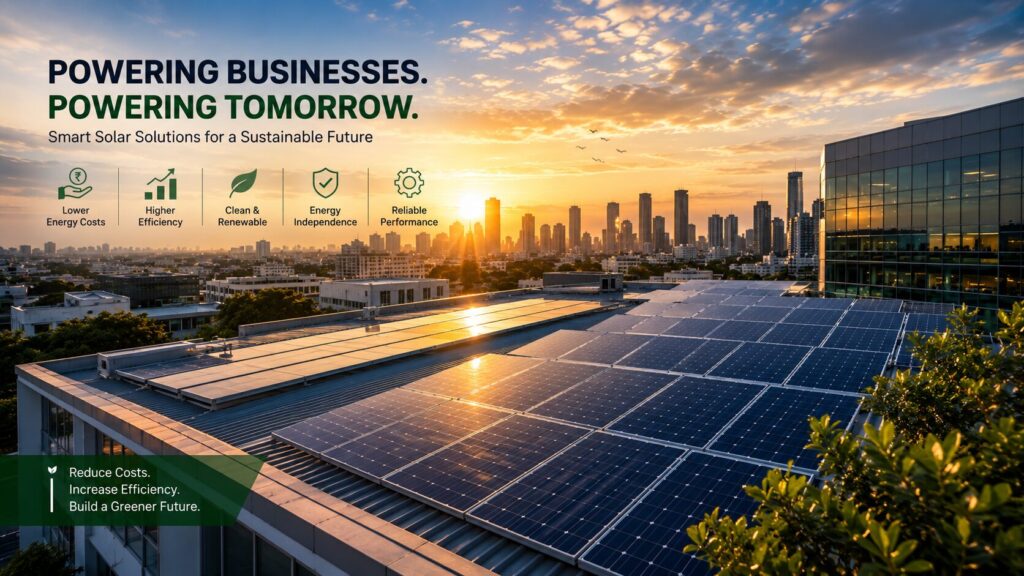
Electricity bills don’t stay flat — they climb every year, and for a business running machinery, HVAC, or long operating hours, that climb hits the bottom line hard. This is exactly why more factories, hotels, hospitals, and offices across India are turning to solar systems for commercial use. Beyond the obvious cost savings, going solar has become a practical, forward-looking decision for any business that wants predictable energy costs and a smaller environmental footprint. At KLK Ventures, a Noida-based company with roots going back over three decades in engineering and manufacturing, this shift toward solar systems for commercial use is something we help businesses navigate every day — from the first energy audit to the final installation. How Solar Systems for Commercial Buildings Actually Work A commercial solar setup isn’t just panels on a roof. It’s a small power plant tailored to your business: Panels capture sunlight and convert it into direct current (DC) electricity. Inverters convert that DC power into usable AC power for lighting, machinery, and equipment. Batteries (optional) store surplus energy for peak hours or outages. Net metering sends any extra power back to the grid, earning credits that lower your bill further. Monitoring tools track performance so maintenance stays minimal and efficiency stays high. The result is a system that draws on a completely natural, renewable resource — sunlight — and turns it into a dependable, everyday power source for your operations. Types of Commercial Solar Systems to Consider Not every business has the same roof space, budget, or power needs, which is why solar systems for commercial use come in a few different formats: Rooftop Solar — the most common choice, using existing roof space efficiently. Grid-Tied Solar — connected to the grid, with net metering credits for surplus generation. Hybrid Solar — solar plus battery storage, useful where outages are frequent. Off-Grid Solar — fully independent systems for locations without reliable grid access. Who Benefits Most Manufacturing units, retail chains and shopping malls, schools and colleges, corporate offices, hotels and resorts, and hospitals are among the businesses seeing the biggest gains from switching to solar. Any operation with high daytime energy use — when solar generation naturally peaks — tends to see the fastest return on investment. The Real Advantages Lower operating costs through reduced electricity expenditure Government incentives, including rebates, grants, and tax benefits for commercial installations Energy independence from grid price hikes and outages Minimal upkeep, since commercial-grade panels typically last 25+ years with low servicing needs A stronger brand image, since sustainability commitments matter to clients, investors, and employees alike Why Businesses Choose KLK Ventures Plenty of vendors will sell you panels. Fewer can carry a commercial project from design through decades of upkeep — which is where KLK Ventures’ three decades of engineering and manufacturing background actually shows up in the details: End-to-End EPC Expertise KLK Ventures handles engineering, procurement, and construction under one roof, so a commercial project doesn’t get split across multiple vendors with conflicting timelines. One team owns the design, the equipment sourcing, and the on-site build. Customized Engineering, Not a Standard Package Every commercial site has a different roof structure, load profile, and shading pattern. Systems are engineered around your actual energy consumption and site conditions, with in-house battery manufacturing giving more flexibility on storage design than a reseller could offer. Experienced Installation Teams Installation is handled by teams who’ve worked across manufacturing plants, hotels, hospitals, and warehouses, not subcontracted out to whoever’s available. That matters for commercial sites, where installation has to work around live operations without disrupting the business. Annual Maintenance Support (AMC) The relationship doesn’t end at commissioning. AMC coverage includes panel cleaning, performance inspection, fault detection, and preventive maintenance, so output stays consistent across the system’s 25+ year lifespan instead of degrading quietly. Key Takeaways Commercial solar systems cut electricity costs while paying for themselves within the panel’s 25+ year lifespan. Rooftop, grid-tied, hybrid, and off-grid are the four main system types — the right one depends on roof space, budget, and outage frequency. Manufacturing units, hotels, hospitals, and retail spaces with high daytime energy use see the fastest returns. Government rebates and tax benefits are available for commercial installations. KLK Ventures offers end-to-end EPC delivery, customized engineering, experienced installation teams, and ongoing AMC support. Frequently Asked Questions 1. How much can a business actually save with a commercial solar system? Savings depend on your current electricity consumption and system size, but most businesses see a meaningful reduction in monthly power bills, with many recovering their investment well within the panel’s 25-year lifespan. 2. Do commercial solar systems work during power outages? A grid-tied system alone won’t provide backup during an outage. For that, a hybrid solar system with battery storage is the better choice, since it keeps critical equipment running when the grid goes down. 3. What government incentives are available for commercial solar in India? Businesses can access rebates, tax benefits, and financing support for commercial solar installations. KLK Ventures assists clients in navigating and applying for these government-backed programs. 4. How much maintenance does a commercial solar system need? Very little. Routine cleaning and periodic performance checks are usually enough to keep a system running efficiently for its full 25+ year lifespan. 5. Is rooftop space always required for a commercial solar system? Rooftop solar is the most common setup, but businesses without adequate roof space can explore ground-mounted or off-grid alternatives depending on land availability. Conclusion Solar systems for commercial use are no longer a niche upgrade — they’re becoming a standard part of how efficient businesses manage energy costs and environmental responsibility. Whether you run a factory, a hotel, or a corporate office, a well-designed solar system pays for itself while reducing your dependence on an increasingly expensive grid. KLK Ventures brings over 30 years of engineering expertise to every installation, helping businesses across India make that switch with confidence. Ready to explore your options? Talk to KLK Ventures about a commercial solar system built around