
Solar Panel Cost in India for Home: 2026 Price, Subsidy and ROI Guide
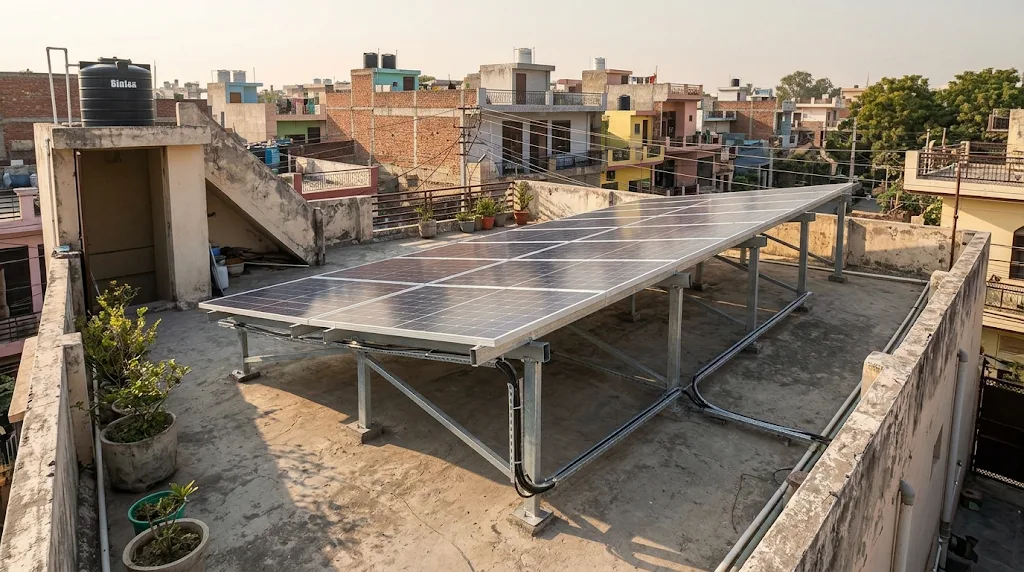
Most online listings confuse bare module rates with turnkey project quotes. In November 2026, the solar panel cost in India for home installations typically ranges from ₹60,000 to ₹85,000 for a 1kW grid-tied system and ₹1.65 lakh to ₹2.10 lakh for a 3kW system before government assistance. Panel-only retail prices sit lower, around ₹24 to ₹36 per watt, because they exclude the inverter, mounting structure, cabling, earthing, and installation labour. If you are planning rooftop solar for your house, KLK Ventures supplies residential solar power systems sized to actual household loads. Solar Panel Cost in India for Home Systems (November 2026) A complete residential quotation covers far more than photovoltaic modules. Based on November 2026 Indian market benchmarks, standard on-grid packages (including DCR panels, string inverter, galvanised mounting structure, DC/AC cables, earthing, surge protection, installation labour, net-metering coordination, and GST) fall within these indicative ranges: System Capacity Approx. Cost Before Subsidy Applicable Subsidy (PM Surya Ghar) Approx. Cost After Subsidy 1kW ₹60,000 to ₹85,000 ₹30,000 ₹30,000 to ₹55,000 2kW ₹1.10 lakh to ₹1.50 lakh ₹60,000 ₹50,000 to ₹90,000 3kW ₹1.65 lakh to ₹2.10 lakh ₹78,000 ₹87,000 to ₹1.32 lakh 4kW ₹2.00 lakh to ₹2.65 lakh ₹78,000 ₹1.22 lakh to ₹1.87 lakh 5kW ₹2.50 lakh to ₹3.35 lakh ₹78,000 ₹1.72 lakh to ₹2.57 lakh 6kW ₹3.00 lakh to ₹3.90 lakh ₹78,000 ₹2.22 lakh to ₹3.12 lakh 10kW ₹4.80 lakh to ₹6.50 lakh ₹78,000 ₹4.02 lakh to ₹5.72 lakh Assumptions (November 2026): Standard on-grid rooftop systems on flat RCC terraces without batteries. Special-category states receive 10% higher Central Financial Assistance per kW under PM Surya Ghar guidelines. Subsidies are credited post-commissioning, so budget for the pre-subsidy figure upfront. Want exact numbers for your terrace instead of broad market ranges? Request an itemised quotation using your recent electricity bills. Factors Affecting Home Solar Installation Costs Two quotes for the same 3kW capacity can differ by ₹35,000 or more because hardware and site conditions change the bill of materials: Cost Factor Technical Variable Impact on Final Quotation System capacity 1kW to 10kW array size Fixed costs spread over more watts, lowering per-kW rate Panel technology Mono PERC vs N-Type TOPCon TOPCon costs more per watt but saves space on compact roofs DCR compliance Domestic cells vs imported cells Subsidy projects require DCR modules, raising module cost Inverter & batteries String, micro, or hybrid + LFP battery Hybrid inverters and batteries add substantial capital cost Roof & structure Standard RCC vs elevated or tin-shed Elevated 8-ft structures add steel and fabrication charges Site & DISCOM Cable length, city logistics, net metering Longer runs, freight, and DISCOM fees increase total outlay Under PM Surya Ghar: Muft Bijli Yojana, subsidised homes must use Domestic Content Requirement (DCR) modules made in India with domestic cells. Since June 2026, ALMM List-II cell rules further govern compliant supply. On-Grid vs Off-Grid vs Hybrid Solar System Costs Your system architecture decides both the initial solar panel cost in India for home buyers and how the house behaves during grid outages. Factor On-Grid System Off-Grid System Hybrid System Grid connection Connected via bidirectional net meter Independent of the utility grid Connected to grid with battery backup Battery None Mandatory battery bank Mandatory battery bank Backup during outage None; shuts down via anti-islanding Full backup within battery capacity Automatic switchover to battery Initial investment Lowest (₹1.65 to ₹2.10 lakh for 3kW) Higher (₹2.40 to ₹4.12 lakh for 3kW) Highest (on-grid plus hybrid inverter and battery) Suitable application Urban homes with reliable grid power Rural homes or weak-grid locations Homes with frequent outages seeking net metering A standard on-grid solar system does not run during a power cut. Under Bureau of Indian Standards anti-islanding rules (IS 16169, enforced under the Solar Systems, Devices and Components Goods Order, 2025), grid-tied inverters disconnect when grid power fails to protect line workers. Homes needing outage backup require an off-grid solar solution or a hybrid system. Government Subsidies and Eligibility in 2026 The central PM Surya Ghar: Muft Bijli Yojana, running through 31 March 2027, provides Direct Benefit Transfer support for grid-connected homes: First 2kW: ₹30,000 per kW (₹60,000 total). Third kW (up to 3kW): ₹18,000 per kW. Above 3kW: Capped at ₹78,000 total central assistance. You cannot treat this subsidy as an upfront dealer discount. Applicants must register on the National Portal, hire a registered vendor using BIS-certified DCR panels (IS 14286 and IS/IEC 61730), pass DISCOM net-meter inspection, and redeem the e-token into their bank or loan account. Although the scheme aims to provide up to 300 free units monthly across one crore households, actual savings depend on local tariffs and usage. Off-grid setups do not qualify. Sizing, Generation, and Solar ROI Calculations Never size a plant by bedroom count alone. Two 3BHK homes can need very different capacities depending on air conditioner hours, geysers, daytime occupancy, or EV charging. Review 12 months of bills, your sanctioned load, and shadow-free roof area (80 to 100 sq. ft. per kW). Across India, 1kW yields roughly 3.5 to 4.5 units daily on average, varying with city, monsoon weather, tilt, shading, dust, and system losses. To estimate payback, use: Simple Payback Period = Net Initial Investment ÷ Annual Net Savings Take an illustrative 3kW on-grid quote of ₹1.85 lakh. Deducting the ₹78,000 subsidy leaves ₹1.07 lakh net investment. At 4,200 units generated annually and an illustrative ₹7 per unit tariff, gross savings equal ₹29,400. Subtracting ₹2,000 for annual cleaning leaves ₹27,400 net savings, yielding an illustrative payback of 3.9 years. Lower export tariffs, shading, module degradation (under 0.5% yearly), loan interest, or inverter replacement around year 8 to 12 will extend this timeline. Installation, Maintenance, and KLK Ventures Proper installation includes shadow analysis, wind-rated mounting, DC/AC protection boxes, earthing, lightning arresters, and net-metering paperwork. Under PM Surya Ghar, registered vendors must provide a five-year Comprehensive Maintenance Contract (CMC), while homeowners should clean panels every two to four weeks in dusty areas. With offices in Noida and Nehru Place, New Delhi, KLK Ventures Private Limited manufactures solar panels, metal