
Commercial Solar Panel Cost in India: Complete 2026 Guide for Businesses
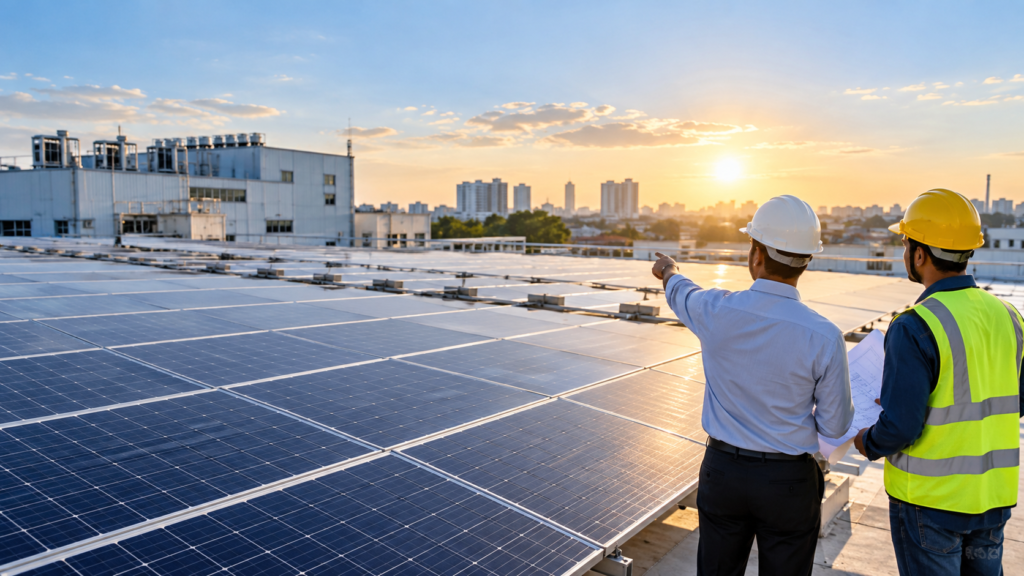
Ask three installers to quote the same roof and you may get three very different numbers. That gap is why commercial solar panel cost deserves a closer look before you speak to any vendor. This guide gives 2026 planning ranges, shows what sits inside a price, and helps you test a quotation against your own bills. Every figure is indicative, not a quote. How Much Does a Commercial Solar System Cost in India? For commercial rooftop solar projects in India, businesses can expect costs of roughly ₹30,000 to ₹50,000 per kW in 2026, equivalent to around ₹30 to ₹50 per watt. The final price can vary depending on the system size, equipment selected, roof structure, installation requirements and project location. How to Calculate Commercial Solar Cost Per kW The quickest check on any quote is its rate per watt. Convert the system size to watts, divide the total price by that number, and compare. A ₹40 lakh offer for 100kW comes to ₹40 a watt. Make sure both quotes cover the same scope first, or the comparison misleads. What Do Commercial Solar Plants Cost from 25kW up to 1MW? System size Indicative total cost 25kW* ₹7.5 to ₹12.5 lakh 50kW ₹15 to ₹25 lakh 100kW ₹30 to ₹50 lakh 500kW ₹1.5 to ₹2.5 crore 1MW ₹3 to ₹5 crore *Calculated from the per-kW band. Other rows follow published installer estimates. For scale, an industry executive quoted by Mercom India put a 1MW behind-the-meter rooftop plant near ₹3 crore, so very large sites often land at the bottom of the range. What Should You Budget for a 100kW Commercial Solar Plant? Plan for ₹30 to ₹50 lakh, fully installed. The gap between the low and high end usually comes down to panel and inverter quality, roof structure, and how far the plant sits from the grid connection point. What Is Included in a Commercial Solar Plant Cost? A turnkey commercial solar plant cost should cover: Solar panels, the biggest line item Inverter, which converts DC to AC power Mounting structure suited to RCC or metal-sheet roofs Electrical equipment such as meters and panels Cables, earthing and protection Installation labour and safety setup Civil work, only where required Testing, commissioning and net-metering approvals You can read more about commercial solar systems and how each component works. What Factors Affect Commercial Solar Panel Cost? Solar panel cost for business projects moves with: System size, as bigger plants cost less per watt Module technology, brand and ALMM compliance Inverter type and capacity Roof condition, height and shading Distance to the grid connection point Local DISCOM approval requirements ALMM is the government’s approved list of module makers. It now covers solar cells from 1 June 2026, so ask vendors for proof (pv magazine India). Rooftop or Ground-Mounted: Which Costs Less? Ground-mounted plants are usually a little cheaper per watt at megawatt scale, but they need land. Commercial rooftop solar cost is slightly higher, yet it puts idle roof space to work. Industrial solar panel cost for a campus with spare land may favour ground mounting. Offices, hospitals and warehouses with spare roof area usually choose rooftop plants connected to the grid, which is what an on-grid solar system delivers. Should a Business Choose CAPEX or a PPA? Under CAPEX, you pay upfront, own the plant and keep the savings and tax benefits. Under a PPA or RESCO model, a developer builds and owns it and you pay per unit. An industry executive quoted by Mercom India recently put RESCO tariffs at about ₹3.5 to ₹3.75 per kWh and CAPEX-model generation cost near ₹2.5 per kWh (Mercom India). Those are one expert’s figures, so ask each vendor to run the numbers against your own tariff. How Does Commercial Solar Affect Business Energy Expenses? It can cut them noticeably if you use power through the day. Solar ROI for businesses depends on tariff, roof and load pattern. A cold storage unit running round the clock uses most of its solar output directly. A hospital with heavy night load offsets mainly its daytime demand, so savings are smaller. Installers commonly quote paybacks of about 3 to 5 years for commercial systems, but treat that as a starting point. Systems in India commonly generate 1,300 to 1,600 units per kW a year. Take a hypothetical 100kW plant at 1,400 units per kW and a ₹8 tariff. That saves about ₹11.2 lakh a year, a simple payback of roughly three and a half years on ₹40 lakh, before maintenance and tax. Use your own bill instead. Are There Subsidies or Tax Benefits for Commercial Solar? GST on solar modules fell from 12% to 5% from 22 September 2025 (pv magazine India). Renewable energy devices, including solar, are listed at 40% depreciation, and the Income-tax Act, 2025 applies from 1 April 2026 (TaxGuru summary). Eligibility and commissioning-date conditions apply, so confirm with your chartered accountant. The PM Surya Ghar scheme is designed for residential consumers. Commercial solar projects may be covered under different central or state-level policies, so businesses should check the latest MNRE guidelines and applicable state schemes before calculating any subsidy or financial benefit. What Size System Does My Business Need? Note 12 months of units from your electricity bills. Divide annual units by about 1,400 for a rough kW size. Check how much load runs in daytime and how much shadow-free roof you have. Look up your sanctioned load and your state DISCOM’s net-metering limits, since both can restrict the plant size you are allowed to connect. A site using 12,000 units a month needs roughly 100kW on paper. For a wider overview, see our guide to commercial solar power systems. What Should I Check Before Accepting a Quotation? Two quotes for 100kW can show the same total and still differ in scope. One may leave out net-metering fees, civil work or the inverter warranty. Ask every vendor for: Cost per watt with an itemised scope Module and inverter make, warranty and ALMM proof Generation estimate and