
Solar Irrigation System: The Complete Guide for Indian Farmers (2026)
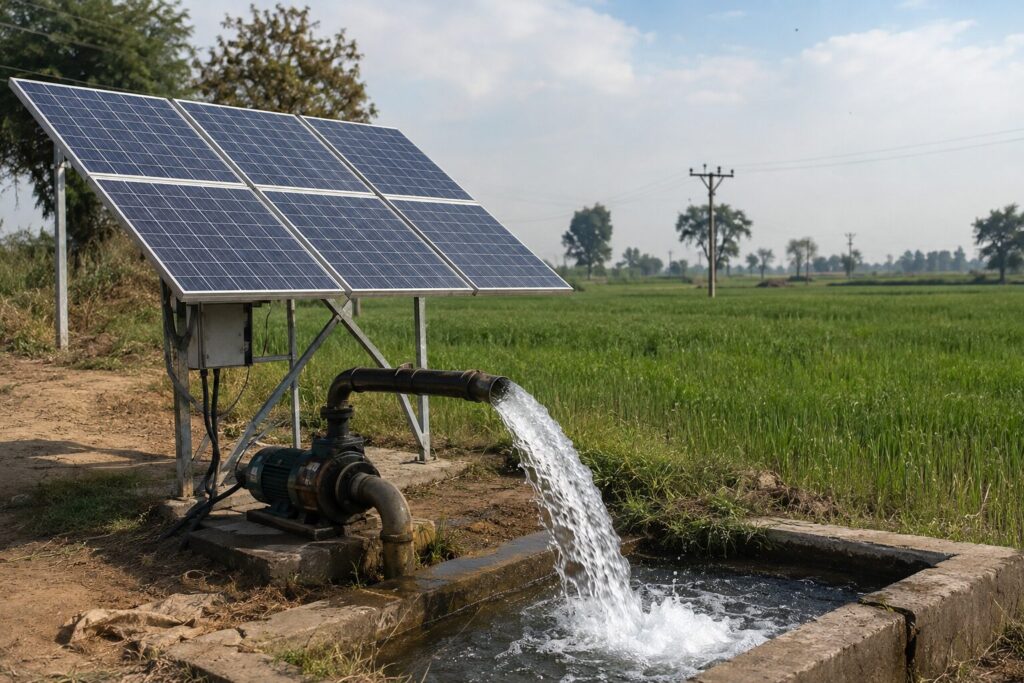
Talk to almost any farmer during sowing season and the conversation eventually lands on diesel prices — that, and the power cuts that always seem to strike right when the field is thirstiest. It’s a strange way to run irrigation: shaping your watering schedule around the discom’s timetable instead of the crop’s actual needs. A solar irrigation system gets you out of that bind. Rather than sitting around for grid power to come back or setting aside cash for the next diesel top-up, the pump simply draws power generated right on your own land. No fuel to buy. No phone calls to the lineman asking when the supply’s coming back. This guide covers how these setups actually function, what they run you, the subsidy support available through India’s PM Kusum Yojana, and how to land on the right configuration for your land — using concrete figures rather than the usual “it depends” non-answer. Want the technical specs first? KLK’s solar water pumping system page breaks down the equipment options in more detail. There’s more farmer-focused reading over on the KLK blog as well. What Exactly Is a Solar Irrigation System? In plain terms, it’s a pumping setup powered by sunlight rather than diesel or grid electricity. Solar panels absorb sunlight and convert it into electric current, which drives a pump that draws water from a borewell, canal, pond, or river and delivers it to the field – via flood irrigation, sprinklers, or drip lines, depending on your setup. Because sunlight doesn’t come with a bill, the ongoing running cost after you’ve installed the system is nearly zero. That’s the core appeal, and it explains why so many farmers are moving over regardless of where diesel prices happen to be sitting this month. You’ll also see this referred to as a solar water pumping system for agriculture or a solar-powered irrigation pump — same setup, different name. How Does a Solar Irrigation System Work? Five components carry most of the workload. Solar panels sit at the front of the process, absorbing sunlight and turning it into DC electricity. Next comes the pump controller — also known as a VFD — which acts as the system’s brain,regulating how much power reaches the pump and buffering against voltage spikes that could otherwise damage the motor. Then there’s the pump itself, either submerged in the water source or mounted above ground, whose job is simply to move the water. A network of pipes routes that water to the field, and a mounting structure keeps the panels angled correctly to capture as much sunlight as possible throughout the day. On a clear day, this entire chain powers the pump in real time — which is why most farm setups skip batteries entirely. Since irrigation almost always happens during daylight hours, there’s usually no need to store power for later. Some farmers do choose to add a battery if they irrigate before sunrise or during long overcast stretches, but for the majority of fields, a direct panel-to-pump connection is simpler and gets the job done. Types of Solar Pumps Used for Irrigation Different farms call for different pumps, and choosing the wrong one is a mistake that tends to get expensive fast Pump Type Best For Notes Submersible DC pump Borewells, deep water sources Runs directly on solar power, highly efficient Submersible AC pump Deep borewells with inverter setup Requires an inverter to convert DC to AC Surface pump Ponds, canals, shallow wells Installed above ground, simpler to service DC pump Small to mid-size farms Loses the least energy in the process Most Indian farms end up somewhere between 1 HP and 10 HP of pump capacity, matched with a solar array ranging from 1 kW to 10 kW or beyond — the exact numbers depend heavily on how deep your water source sits and the size of the land you’re covering. KLK’s site assessment process exists precisely to get that match right before any equipment goes in the ground. Why Farmers Are Making the Switch The recurring fuel expense disappears entirely once the system is up and running. You’re no longer waiting on the discom’s schedule — water the field whenever the crop actually needs it. Set against a diesel pump, most systems recover their upfront cost within just a few irrigation seasons. Far fewer things can break down mechanically — no engine, no oil changes, none of the moving parts a diesel genset relies on. Programs like PM-KUSUM shave a meaningful chunk off the initial investment. There’s an environmental upside too — no emissions, and no risk of fuel seeping into the water source. Not sure what size system fits your land? Get a free site visit and subsidy check from KLK Ventures — call +0120 4549038. What Does It Cost, and What Subsidy Can You Get? Costs shift quite a bit depending on pump size, panel wattage, and the specifics of your site — water depth, distance to the field, and so on. As a rough starting point, though: A 2 HP pump typically pairs with a 2 kW–3 kW solar array. Move up to 5 HP, and you’re generally in the 6 kW–7.5 kW range Larger commercial setups scale further from there. The upside is that the PM Kusum Yojana was built specifically to soften this cost — central and state governments each contribute toward the subsidy for eligible farmers, which can bring the amount you pay out of pocket down substantially. Even so, the exact percentage and eligibility criteria shift from state to state, so it’s worth checking the current figures before you finalize a budget. How to Pick the Right System for Your Land Start with your water source. A deep borewell needs a submersible pump; a pond or canal is better suited to a surface pump. Calculate your actual water requirement based on crop type, land size, and irrigation method — flood, sprinkler, and drip all draw water differently. Match the pump’s