
Solar Water Pump Installation: A Practical Guide for Indian Farms and Properties
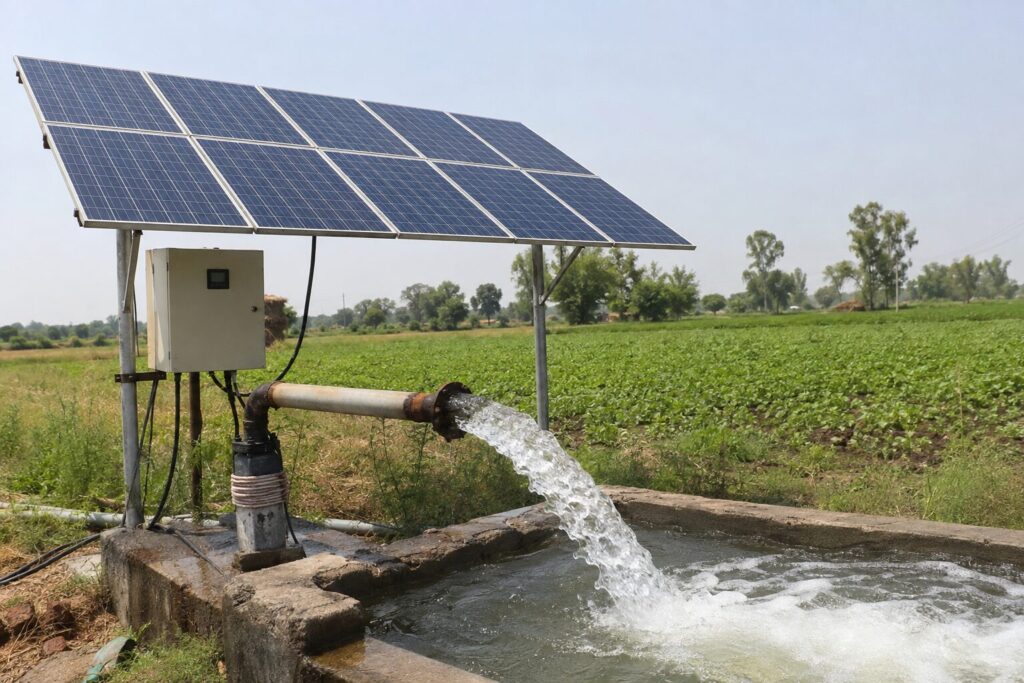
Diesel prices don’t go down. That’s the blunt truth behind why so many farmers and rural landowners in India are looking at solar water pump installation right now. If you’re currently running a pump on diesel, or fighting an electricity connection that cuts out right when your crop needs water most, solar solves both headaches at once — it runs on sunlight, and sunlight doesn’t send a bill. This guide walks through how installation actually happens on the ground, what it costs, where government subsidies come in, and the mistakes that trip up a lot of first-time buyers. What Is Solar Water Pump Installation? Solar water pump installation means setting up solar panels, a pump controller, a water pump, and the pipework needed so sunlight — not diesel or grid power — does the job of pulling water out of the ground and getting it where it needs to go. Here’s the basic chain: the panels catch sunlight and turn it into DC electricity. That power runs through a controller, which is really just the brain of the system — it makes sure the pump gets a steady, safe supply instead of getting fried by a sudden surge. The pump itself does the physical work, drawing water from a well, borewell, river, or pond and pushing it through pipes to the field, a storage tank, or a livestock trough. Once it’s installed, there’s no fuel to buy. The sun shows up for free every day, and the system just uses it. How Does It Actually Work, Step by Step? Most installations, done properly, go through four stages: 1 Site assessment — someone actually visits and checks your water source, how deep it is, how much flow you need, and how many hours of usable sunlight your site gets. 2 System sizing — matching panel wattage (usually somewhere between 500W and 5000W), pump type, and voltage (12V up to 72V) to what your land and water source actually demand. 3 Installation — mounting the panels, wiring the controller, placing the pump, and running pipe to wherever the water needs to end up. 4 Testing and handover — checking that the flow rate is what it should be, that the controller reacts properly as sunlight changes through the day, and walking the owner through basic upkeep. Honestly, the assessment stage is where things go wrong most often. Installers who skip it — or rush it — tend to hand over systems that look fine on paper but can’t keep up once peak irrigation season hits. Types of Solar Water Pumps Pump Type Best Suited For Key Trait Submersible Deep wells, borewells Fully submerged, handles greater depth Surface Shallow wells, rivers, tanks Sits above the water source DC Pump Standalone solar setups Runs directly off panel output AC Pump Hybrid or grid-linked setups Uses an inverter to convert DC to AC Which one you need really comes down to how deep your water source is and whether the pump has to work alongside existing AC-powered equipment. Benefits of Solar Water Pump Installation • Lower running costs — once it’s installed, there’s no recurring diesel expense eating into your margins • Water access you can count on — works fine in areas the grid barely reaches • Less maintenance hassle — fewer moving parts than a diesel engine means fewer things to break • Smaller environmental footprint — less reliance on fossil fuel, fewer emissions • Government support exists — schemes like PM-KUSUM offer subsidies on eligible installations, though how much you actually get depends on your state, so it’s worth checking before you plan your budget around a specific number Common Mistakes to Avoid A lot of the problems people run into later trace back to shortcuts taken early on: • Picking pump capacity based on price instead of what your land actually needs • Not accounting for shade from nearby trees or buildings when placing panels • Skipping a storage tank, then struggling on cloudy days • Forgetting to factor in total dynamic head — that’s the vertical lift plus friction loss in the pipes • Going with an installer who never actually visits the site before quoting How to Choose the Right System Before you sign off on anything, get clear answers on a few things: how much water you need daily, in litres; your total head; how many sunlight hours your location realistically gets; and whether your site even qualifies for PM-KUSUM or a state-level subsidy. If an installer is willing to size your system around these specifics rather than just selling you whatever package they have on hand, that’s usually a good sign. KLK Ventures Pvt. Ltd., based in Noida and working on projects across NCR and pan-India, follows exactly this approach — assessing the water source, designing a configuration that actually fits, handling the installation itself, and helping clients work through the subsidy paperwork. Their solar water pumping system service covers agricultural irrigation, livestock watering, and rural domestic use. Conclusion Solar water pump installation isn’t complicated in theory, but getting it right depends on details most people don’t think about until something goes wrong — sizing, site assessment, installer quality. Done properly, it cuts your diesel or electricity costs and gives you water access that doesn’t depend on the grid staying up. If you’re weighing solar water pump installation for a farm or rural property, the installer’s willingness to actually assess your site — rather than push a standard package — is usually what separates a system that works from one that disappoints you in July. Frequently Asked Questions 1.How much does solar water pump installation cost in India? It depends on pump capacity, panel wattage, and your site conditions. PM-KUSUM subsidies can bring the upfront cost down a lot for eligible farmers, but the exact percentage varies by state, so don’t assume a figure without checking. 2.Is solar water pump installation suitable for deep borewells? Yes — submersible