
Commercial Solar Power Systems: The Complete Guide for Indian Businesses (2026)
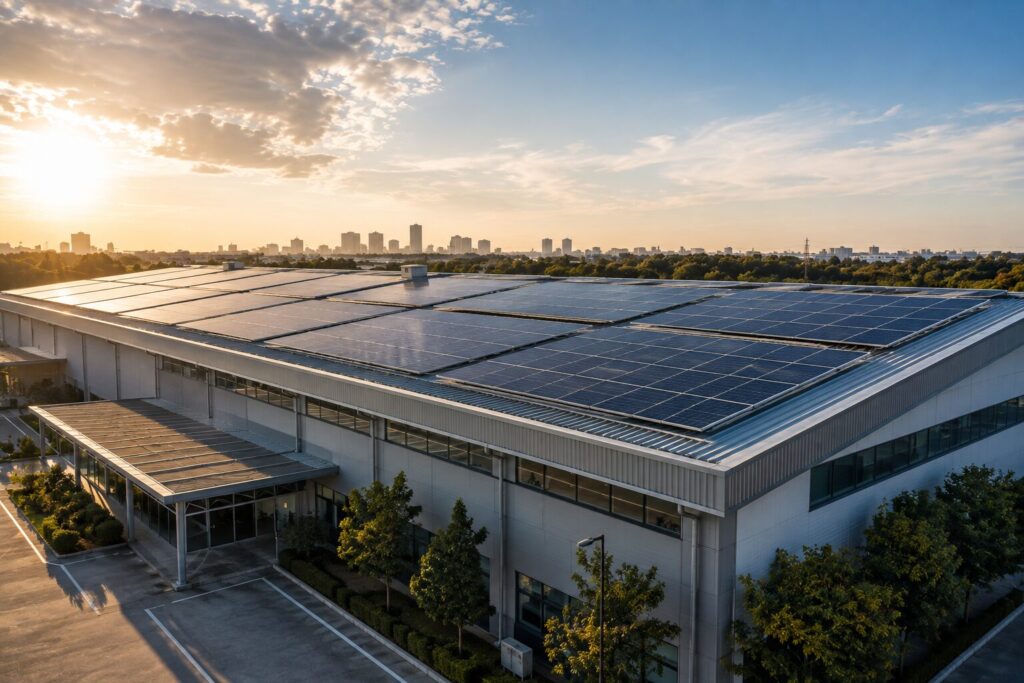
Every business owner reaches the same point eventually — staring at an electricity bill that keeps climbing no matter how carefully the numbers are managed. For factories, warehouses, offices, and retail spaces across India, power is often one of the largest fixed costs. A commercial solar power system in India offers a practical way for businesses to reduce electricity expenses, improve energy efficiency, and gain greater control over long-term operating costs. As electricity tariffs continue to rise and solar technology becomes more accessible, more businesses are turning to commercial solar solutions as a cost-effective energy investment. What Is a Commercial Solar Power System? A commercial solar power system is a solar installation engineered for business use, such as factories, offices, hospitals, warehouses, and commercial complexes are sized to handle far higher loads and longer operating hours than a residential rooftop setup. Types of Commercial Solar Systems On-Grid: Connected to the utility grid, with surplus power exported through net metering. Off-Grid: Independent of grid supply, suited to remote or unreliable-grid sites. Hybrid: Grid-connected with battery storage for continuity during outages. How Does It Work? A commercial system is built around solar PV modules, an inverter, mounting structures, a net meter, and a monitoring system sized to the facility’s load profile. A proper project starts with a site survey, followed by design, approvals, installation, and commissioning. What Does It Cost? Cost depends on capacity, site conditions, and module quality, so any figure should be treated as an estimate pending a site assessment. As a general reference, commercial rooftop systems in India commonly range from ₹35,000–₹45,000 per kW installed, varying by state and structure type. Financing Routes Businesses typically choose the following: CAPEX: The business owns the system and captures the full savings along with applicable tax depreciation. RESCO/OPEX: A developer owns and maintains the system, while the business pays a lower per-unit tariff with little upfront cost. For CAPEX buyers, the document notes that Section 32 of the Income Tax Act allows 40% first-year accelerated depreciation under the written-down value method when commissioned before 1 October, subject to the applicable rules. Businesses should confirm the tax treatment with a chartered accountant. From June 2026, MNRE also requires commercial and industrial solar projects to use ALMM list-II-listed modules. Why Are Businesses Switching? Commercial and industrial tariffs run considerably higher than residential rates, so solar savings can be proportionally larger for businesses. With accelerated depreciation and falling equipment costs, payback typically lands between three and six years, with systems generating power for 25 years or more, depending on the site and financing route. Solar also reduces exposure to tariff hikes and diesel backup costs, making budgeting easier. Key Numbers 3–6 years: Typical payback period 25+ years: System lifespan 40%: First-year depreciation* Best-Fit Industries and Local Fit Manufacturing plants, warehouses, hospitals, hotels, and educational institutions can see fast returns because daytime consumption aligns with peak solar generation. Noida and the wider Delhi-NCR region receive strong, consistent solar irradiance, and Uttar Pradesh’s net metering framework allows eligible commercial consumers to export surplus power to the grid, although timelines should be confirmed with the local DISCOM. Businesses in this region generally benefit from working with a locally based installer that understands regional DISCOM processes. Why Choose KLK Ventures? KLK Ventures began as K.L. Khanna Gears Industries, manufacturing precision industrial gears for more than three decades, before moving into renewable energy. That industrial background now informs its approach to project quality. KLK Ventures offers end-to-end delivery covering: Site assessment System design Installation Commissioning Ongoing solar maintenance On-grid systems Off-grid systems The team is based in Sector-58, Noida, and is led by CEO Akshat Jain, whose background spans energy, trading, and accounting. Ready to See What Your Business Could Save? Get a free site assessment and quote from KLK Ventures. Phone: +0120 4549038Email: info@klkindia.com Frequently Asked Questions What is a commercial solar power system? A solar installation designed for business use, sized for higher loads and longer operating hours than a residential setup. How much does it cost in India? Commercial solar systems typically cost around ₹35,000–₹45,000 per kW as a general estimate. A site assessment is required for an accurate quotation. How long is the payback period? The estimated payback period is roughly three to six years, depending on savings, depreciation, incentives, site conditions, and the financing model. Can businesses sell excess solar power to the grid? Yes. Businesses can export surplus solar power under applicable state net-metering policies, including in Uttar Pradesh, subject to DISCOM approval. Is accelerated depreciation still available in 2026? The document states that 40% first-year depreciation under Section 32 is available if the system is commissioned before 1 October, subject to applicable rules. Businesses should confirm the treatment with a chartered accountant.